Setting up a granite crushing plant requires careful planning to optimize output and product quality. Below is a step-by-step breakdown of key components and processes.
1. Primary Jaw Crusher: Breaks large granite blocks (<800mm) into smaller pieces (150-300mm). Example model: PE-600×900 (Capacity: 50-160 t/h, Power: 55-75 kW).
2. Secondary Cone Crusher: Further crushes material to 20-50mm. Recommended: HPT300 (Capacity: 90-350 t/h, Closed-side setting: 6-38mm).
3. Tertiary Impact Crusher/VSI: Produces cubic-shaped sand (0-5mm) for high-grade concrete. Example: VSI1140 (Throughput: 200-400 t/h, Max feed size: 50mm).
4. Vibrating Screens: Multi-deck screens (e.g., 3YK3070) separate aggregates into 0-5mm, 5-10mm, 10-20mm, and 20-31.5mm fractions.
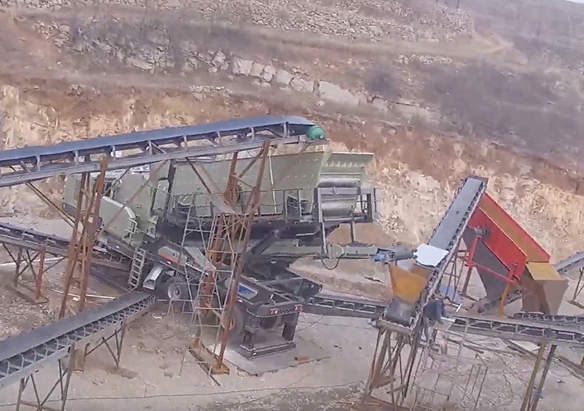
| Equipment | Model | Capacity (t/h) | Output Size (mm) | Power (kW) |
|——————–|————|—————-|——————|————|
| Jaw Crusher | PE-750×1060| 110-320 | ≤630 | 110 |
| Cone Crusher | HST250 | 120-340 | ≤35 | 250 |
| VSI Crusher | VSI5X1145 | 260-520 | ≤50 | 440 |
Q1: How to reduce dust in granite crushing?
A: Use water spray systems + pulse bag filters at transfer points.
Q2: What’s the ideal granite hardness for sand production?
A: Mohs hardness of 6–7 (e.g., G603/G654 granite) balances wear and fragmentation efficiency.
Project: Fujian Province, China (2023)
Output: 500 t/h